





The Rules of Textile Sourcing Have Changed: Price Is No Longer the Only Priority
If you're sourcing performance fabrics the same way you did three years ago, your risk map may already be outdated. What was once a competition based on cost, capacity, and lead time is now increasingly shaped by factors that are harder to replicate: tariff exposure, supply-chain resilience, product transparency, and sustainability compliance.
As a Taiwanese functional fabric manufacturer, we see this every month as brands rebuild their sourcing maps. Buyers are no longer asking only, "What's your price per meter?" They're asking, "Can you prove it, can you certify it, and can you keep delivering it when the trade rules shift again?"
This shift is one reason Taiwan is gaining greater strategic importance in global textile sourcing.
What's Actually Driving the Shift
Two regulatory forces are doing most of the work, and both raise the bar on what a fabric supplier has to deliver:
The EU is turning sustainability into a market entry ticket. Under the Sustainable and Circular Textiles Strategy, textiles are expected to be durable, repairable, and recyclable. For brands selling into Europe, this isn't a marketing line anymore; it's a procurement standard.
US tariff policy and the "China+1" sourcing strategy have moved from theory into purchasing decisions. Nearshoring toward Vietnam, India, Mexico, and Latin America is now reflected in the order books, alongside a clear premium on delivery flexibility and supply stability.
For buyers, the message is consistent: the cheapest commodity fabric is the most exposed, and the high-function, traceable, low-risk fabric is the one worth building a relationship around.
How Every Sourcing Region is Repositioning — and what it means for your risk
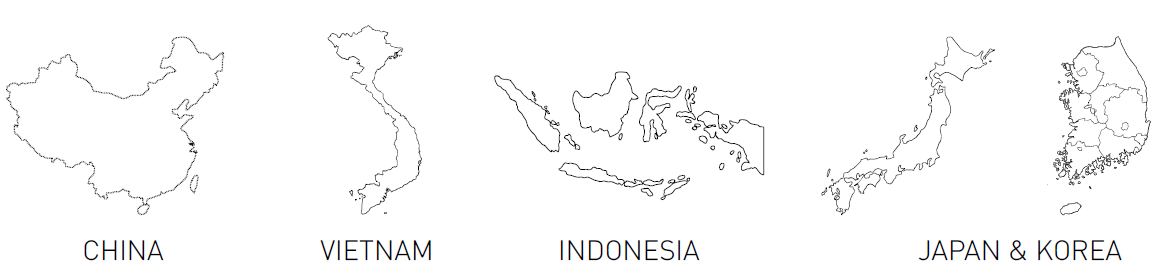
China — from garment hub to upstream integration power
- Repositioning: moving from a garment-export hub to upstream raw-material and fabric integration power; its fabric and yarn export scale remains formidable.
- Competitive edge: no longer just low price — it's scale plus automation plus material integration.
- Sourcing watch-out: for US-bound apparel programs, concentration here means concentrated tariff and geopolitical exposure.
Vietnam — a capacity-led contender moving upmarket
- Repositioning: graduated from "transfer-order beneficiary" to a real player in high-value, greener supply chains, building integrated textile parks.
- Competitive edge: strong manufacturing capacity with increasing investment in sustainability.
- Sourcing watch-out: strength is still capacity-led; competes hardest on standardized, high-volume programs.
Indonesia — the long-term backfill story
- Repositioning: safeguard tariffs and a 2035 textile-revival roadmap guiding industry upgrade.
- Competitive edge: large domestic market and a young workforce.
- Sourcing watch-out: real potential, but still maturing.
Japan & Korea — high-end material specialists
- Repositioning: deep specialists in high-end technical materials and industrial textiles.
- Competitive edge: complete solutions across application, verification, and innovation.
- Sourcing watch-out: niche and premium — not the answer for breadth or price.
In that line-up, Taiwan occupies a distinct and increasingly valuable position: not the volume leader, but the capability leader for performance and proof.
Why Taiwan: product power and data power from a single supplier

Here's the part that matters most to your sourcing strategy. Taiwan doesn't try to win the volume race — it wins the capability race, and it does so by combining things most regions deliver separately: high-end technical performance, audit-ready data, development flexibility, and solutions that deliver both performance and value.
This combination creates a compelling sourcing proposition for brands seeking both technical performance and commercial viability: High technical performance and competitive pricing in the same package, so brands don't have to trade one off against the other.